

What Size Trowel For 2x2 Mosaic Floor Tile
Before you begin setting tile, decide which tile trowel to use. What should be the correct size? Should I use a U-notched or a squared-notched trowel? Those are common questions you must ask yourself earlier starting your installation project. Basically, there is not a standard trowel size for tile installation, since it depends on the size and blazon of tile you lot install. Each type of tile may require a differently sized trowel. Be concerned with the amount of coverage for the tile.
For example; you have two different 24" x 24" tiles for ii different floors. Although they are the aforementioned dimension, each tile may crave a unlike trowel size. If i of the tiles is adequately flat with minimum warping (cupping), you may come across the proper coverage requirement using a 3/8" foursquare-notched trowel. If, however, the other tile has quite a bit of cupping yous may need to use a larger 1/2" square-notched tile trowel to get proper coverage.
Proper thinset mortar coverage means a minimum of 85% total coverage beneath a tile for a dry area installation (well-nigh floors, fireplace, etc.) and 95% minimum total coverage in a wet area (showers, tub surrounds, etc.). There is more to that requirement such equally complete coverage beneath all four corners of the tile, but those are the basics.

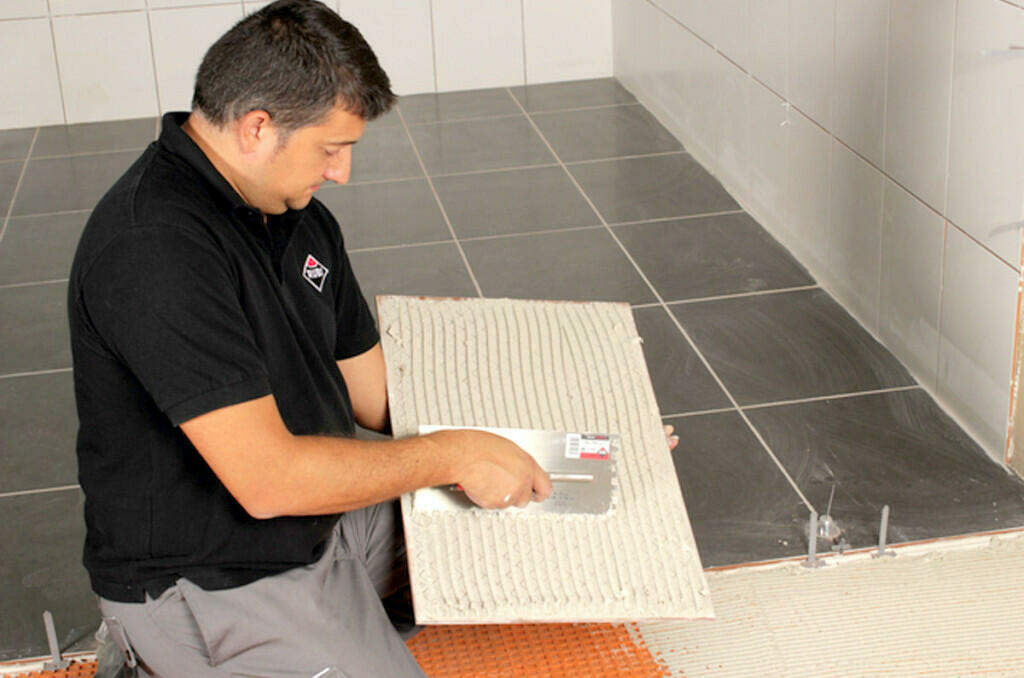
To go proper coverage yous need to cull the right sized trowel, one that will requite yous that amount of coverage beneath the tile. Check this by installing the tile equally yous unremarkably would, and then pulling the tile up and checking the dorsum. There should no longer exist whatsoever trowel lines and yous will see complete coverage of thinset on both the back of the tile and the substrate.
How trowel sizes are measured
The size and spacing of the trowel teeth are the basis to measure trowel size for tile. This tells you how much thinset the trowel volition leave on the substrate when you spread information technology out. The trowel'southward tooth shape and spacing determines how much thinset is sandwiched betwixt the tile and substrate once the tile is fully installed.
RUBI manufactures tile trowels in two basic types, the square-notched and the U-notched. They are measured in the same fashion, the first number is the width of the notches (the distance between the teeth), the 2nd number is the depth of the notch.
Square-notched trowel
- Using a ane/2" x 1/2" square-notched trowel will leave i/2" ridges of thinset on the substrate with 1/2" spaces between each ridge. A tile trowel with simply one measurement (i.e. as 1/two" trowel) means that both measurements are the same.
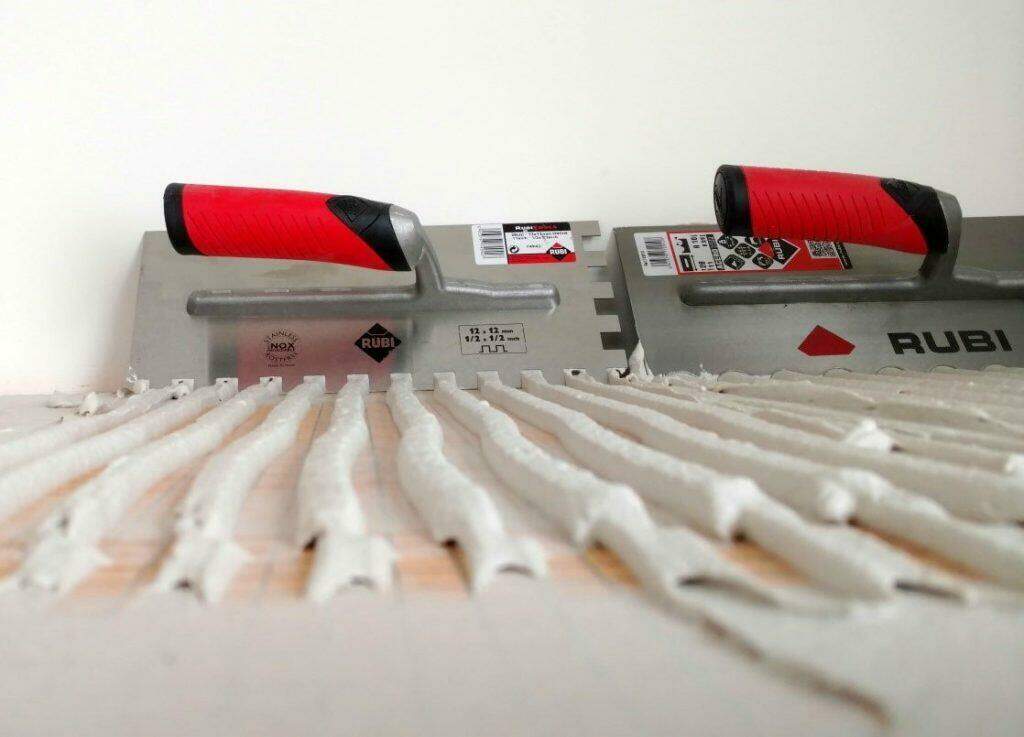
- When you apply a 1/4" x 3/8" foursquare-notched trowel you lot will leave i/4" wide by 3/8" high ridges of thinset on the substrate, with ¼" spaces betwixt each ridge.
U-notched trowel
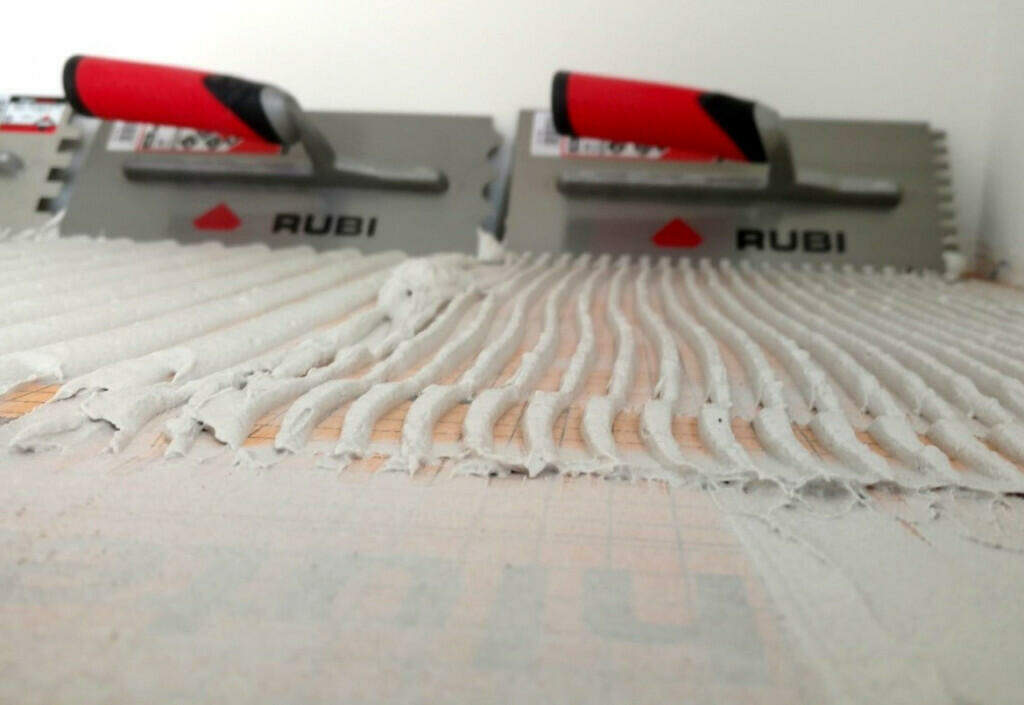
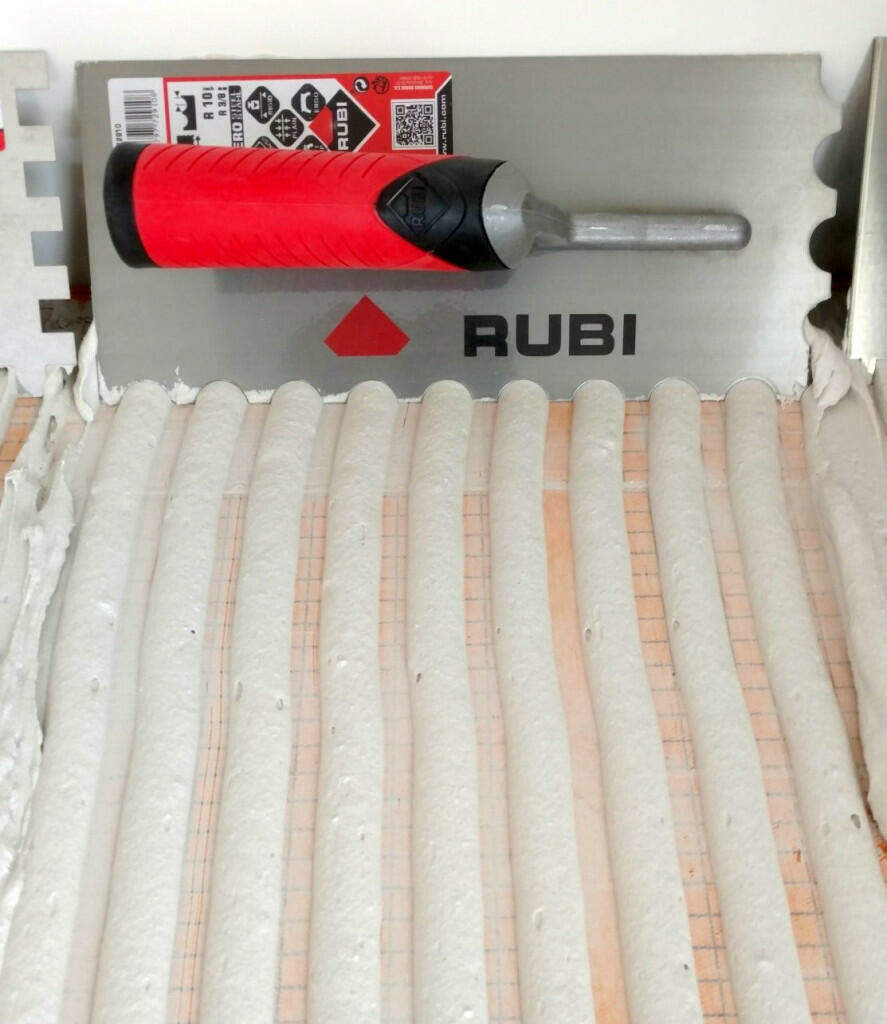
U-notched trowels ordinarily only have one number. This is both the width and depth of the teeth. I am using a 3/8" U-notched trowel, which has a half-moon shaped notch.
When you spread thinset with a U-notched trowel, it will leave half-round ridges on the substrate. The height of the ridges and the space betwixt each ridge volition exist the size of the trowel (in this case 3/eight"). The width of each ridge will DOUBLE the trowel size – iii/4".
How much thinset will a trowel leave nether the tile
The trowel size for tile determines how much thinset to put on the substrate, equally well equally how thick the bed of thinset should be under the tile.
When you use a square-notched trowel with the same size notch and teeth (i.e. a one/ii" x 1/2"), the bed of thinset will be one-half of that measurement, or 1/4", beneath a flat tile over a flat substrate.
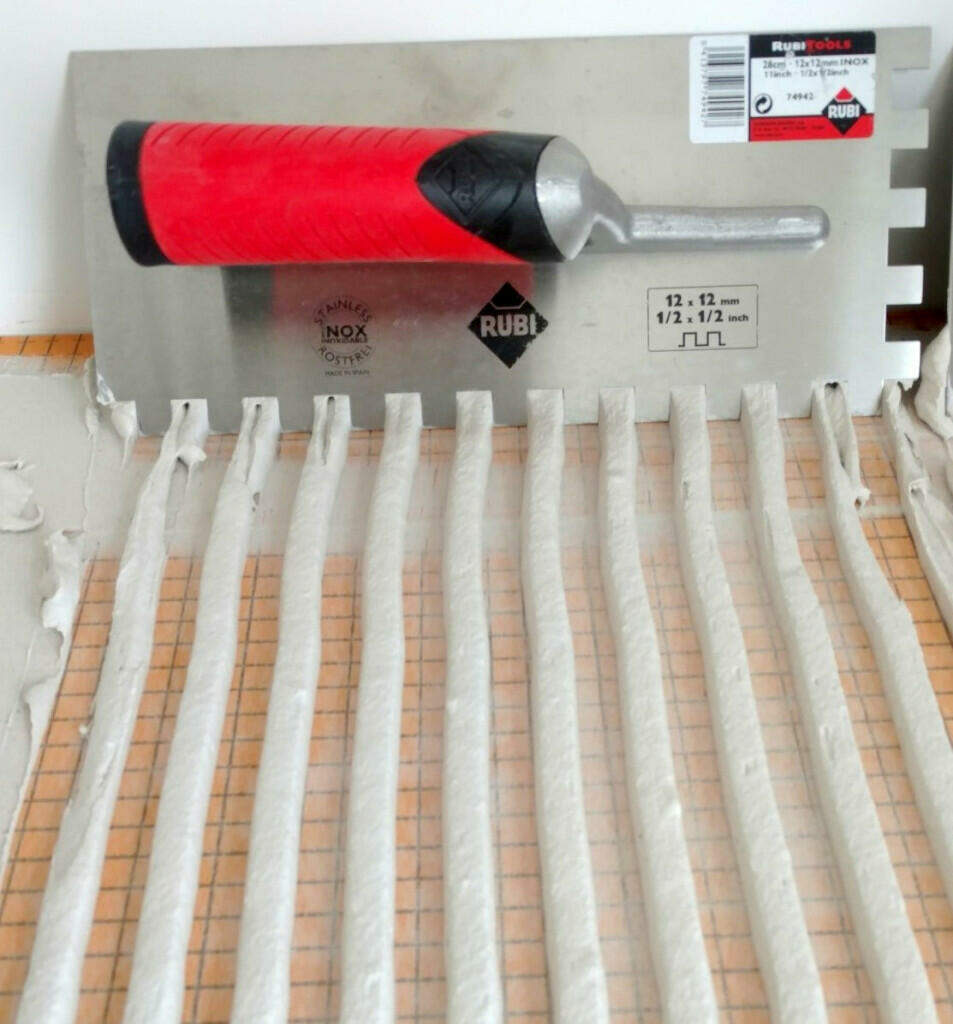
When you fully embed the tile into the bed of thinset, it spreads out the thinset ridges evenly into the spaces between the trowel lines. Since the spaces between the ridges take the same size every bit the ridges themselves, this volition split the height of the ridges in half. So a ane/2" ten one/2" trowel will leave a i/4" high bed of thinset beneath the tile. A 3/8" 10 3/viii"' trowel will go out a 3/16" bed of thinset beneath the tile.
Using a U-notched trowel and embedding the tile into the thinset leaves yous with a bed of thinset below the tile a little over ane/3 the size of the trowel teeth. Then a three/8" U-notched trowel leaves a 1/viii" bed of thinset beneath the installed tile.

U-notched or foursquare-notched trowel? Which shape of tile trowel to apply
Since a 3/8" U-notched trowel and a 1/iv" square-notched trowel will both leave a one/8" layer of thinset mortar beneath an installed tile, why choose one over the other?
The difference in trowel-notch shapes determines how hands the tile becomes fully embedded in the bed of thinset. In basic terms, it is easier to wiggle a tile into a bed of thinset put downwardly with a u-notched than with a square-notched. You lot collapse rounded ridges rather than square ridges.
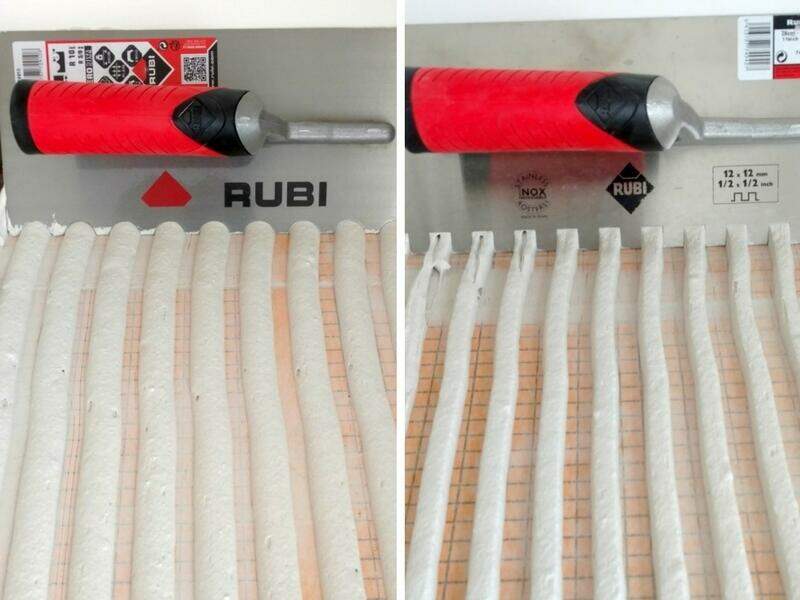
The square ridges, put down with a square-notched trowel, tend to plummet over on each side when you embed the tile into the bed. Pushing the tile downwardly into the bed of foursquare ridges causes the ridges to fold over from the summit of the ridge, so spread out.
A U-shaped ridge, on the other hand, spreads OUT when embedding a tile into the bed. Pushing a tile into the bed of rounded ridges causes the ridge of thinset to spread out, from the bottom, with less possibility of trapping air.
Which trowel size for tile to apply
Determining which trowel size is proper for your installation depends on both the tile itself and the substrate. More accurately, it depends on how flat the tile and substrate are. The less flat the tile is, the more than thinset mortar you demand beneath it, which means a larger trowel size.
First, yous must know how much thinset mortar yous want beneath the tile in the finished installation. A finished installation requires a minimum of three/32" below the finished installation, aiming for a 1/8" minimum makes it easier to summate the proper tile trowel size.
There are two basic means to make up one's mind which size of the trowel to apply: computing the warpage (cupping) of the tile and substrate or visual inspection.
Calculating the warpage (cupping)
Cupping of the tile means the amount of variation from the plane. That's only a fancy way of saying how 'out of flat' your tile is. Figure this out past placing the tile confront-to-face and squeezing ane corner. If the tile is cupped, the opposite corner volition not be contiguous, it will spread apart. Measure out the corporeality of space between the faces of the tile on the opposite corner then dissever that number in half. That is the amount of cupping in the tile.
If squeezing the tile in this manner produces a one/4" space betwixt the tiles in the contrary corner, it ways the tile is cupped by i/8". Yous must add together this amount to the minimum thinset corporeality you lot desire beneath the tile in social club to become proper coverage!
If y'all want a minimum of 1/8" bed of thinset beneath the tile cupped by i/8", you lot must use a trowel that will leave a 1/4" bed of thinset beneath the finished installation. A 1/2" square-notched trowel will accomplish the proper coverage in that case.
Visual inspection
Visual inspection is only fully embedding the tile into the bed of thinset mortar, then removing information technology and looking at both the substrate and the back of the tile to decide whether you have proper coverage.
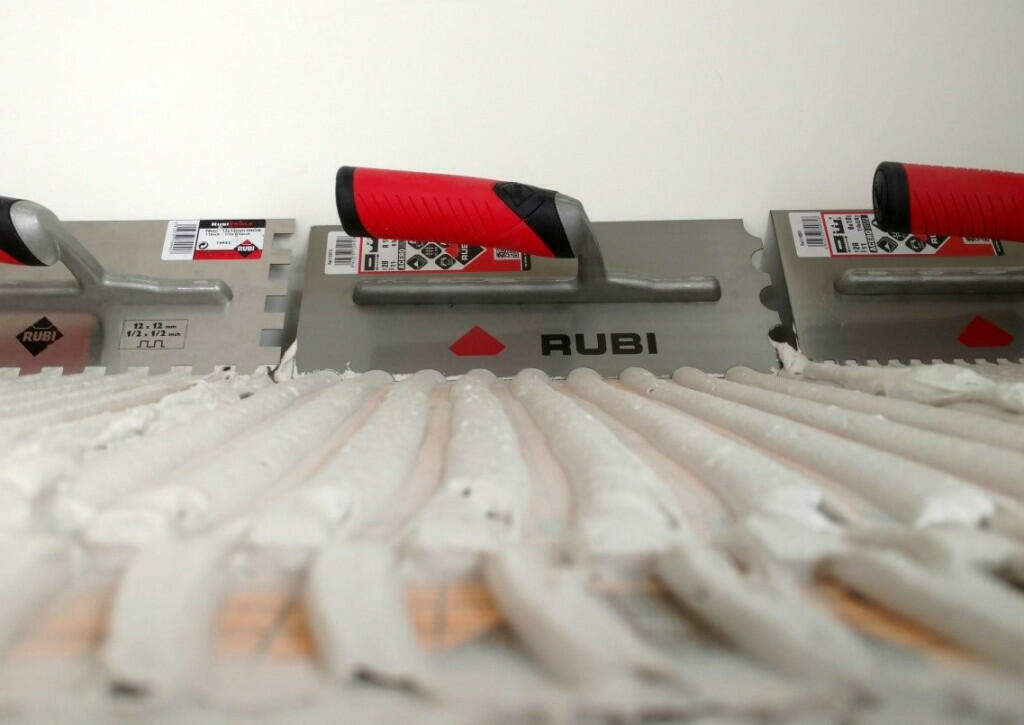
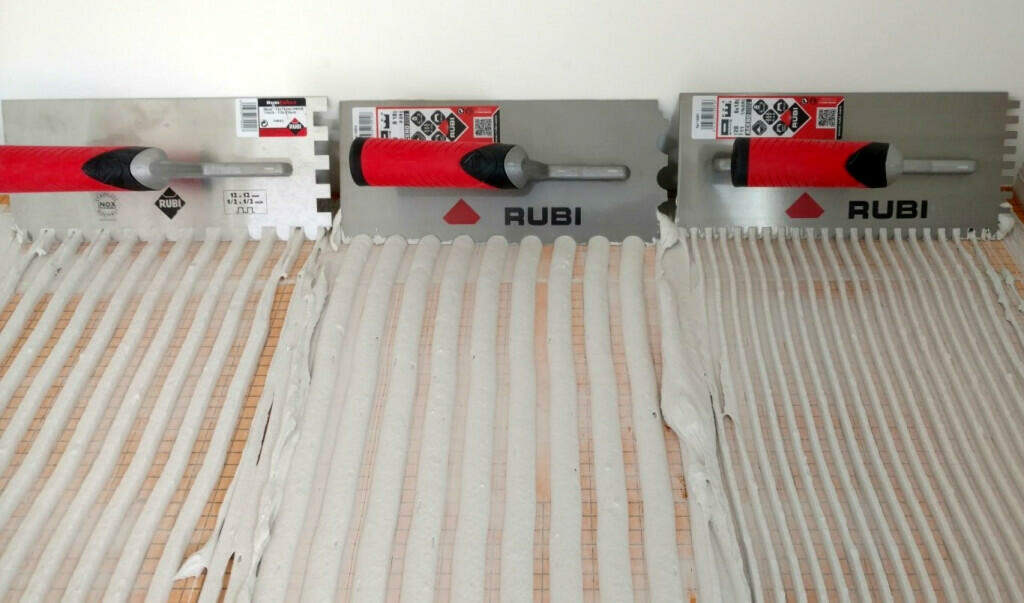
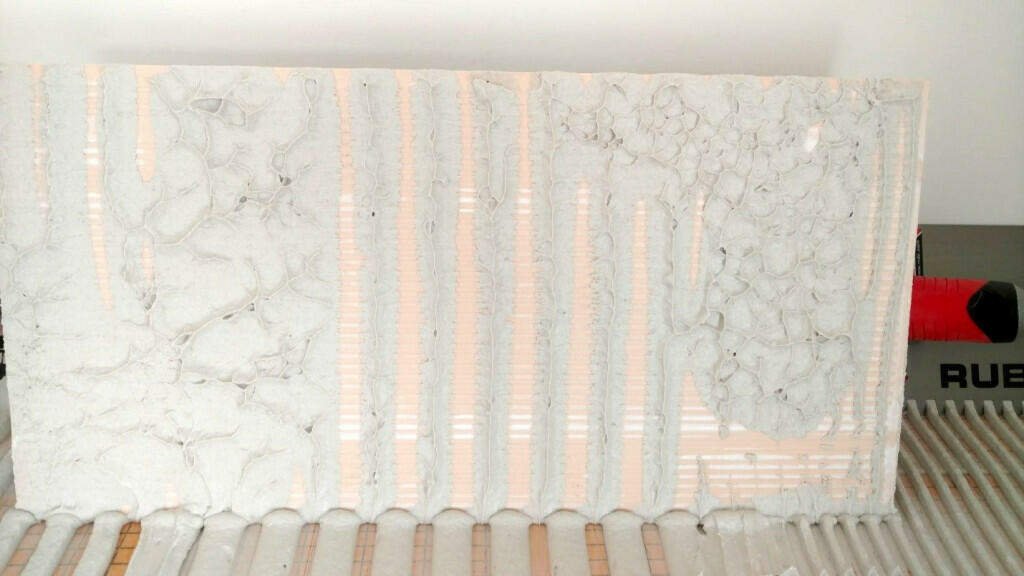
This tile was pushed downward only most halfway into the bed of thinset. Notice the 1/2" square notched bed on the left side has the most coverage with the 3/8" square notch in a shut second. The u-notch in the center has fifty-fifty coverage, merely you lot need a much larger notch to go the aforementioned amount of coverage.
What's The Trowel Size for a 12×24 Tile?
When you summate the amount of cupping in the tile to make up one's mind the properly sized trowel, you still need to visually inspect the coverage to ensure you use the proper size of the trowel!
To apply what nosotros've learned in this article more practically, let's consider the correct trowel size for 12×24" tile? What kind of notches should information technology have? Well, in perfectly flat conditions nosotros want a layer of agglutinative that's 1/viii" to 1/4" thick.
But in existent life, weather are rarely perfect, and then let's assume that nosotros have about a ane/16th inch of cupping. Like we said before, we need to add the lippage to the normal recommended thickness for our adhesive layer.
This gets us a layer between 3/xvith and 5/16th inches thick, which is most a quarter inch.
Next, we need to multiply this thickness of mortar past two, for foursquare notches, or 3, for U notches, to figure out the ideal notch dimensions of our trowel. This comes out to square notches of 1/2 inch by ane/2 inch or a rounded notches of 3/4 inch.
And at that place yous have information technology! You've found the ideal notch size for your trowel!
Personal preferences
To a higher place and beyond using the proper method to go proper coverage for a successful installation, your personal preference will help determine which specific tile trowel y'all use for different types of installation.
Equally a rule, the larger the tile the larger the trowel. It is always improve to apply a larger trowel than yous might need for the installation. A piffling extra thinset beneath a tile is completely acceptable, not enough thinset beneath the tile is non adequate.
U-notched vs. square-notched is a personal preference. While it is easier to obtain complete coverage with a U-notched, you must also use a larger U-notched trowel to attain the same bed thickness beneath the installed tile. This is sometimes difficult with vertical installations. It is easier to keep a standing ridge on a wall with smaller square-notched than with a larger U-notched.
U-notched trowels make it easier to keep thinset out of the grout lines as yous embed the tile. There is more infinite between the half-moon ridges with a U-notched than there is with a square-notched. This makes information technology easier to take the tile drop into the bed with the edge over an open up expanse between the ridges than over the top of a standing ridge. Since the thinset spreads out, rather than folding over get-go, it is less likely that the thinset will make full the grout line every bit you embed the tile.
Your turn! Let me know your tips to choose the right trowel size for tile!


What Size Trowel For 2x2 Mosaic Floor Tile,
Source: https://www.rubi.com/us/blog/trowel-size-for-tile/
Posted by: griffininlyrib.blogspot.com
0 Response to "What Size Trowel For 2x2 Mosaic Floor Tile"
Post a Comment